Summary
Which educational approaches in ICSE schools mould students’ practical learning journey? The blog examines essential practical learning within the ICSE curriculum through examinations of experiments with real-world applications that boost student comprehension. This method educates students to think critically while it improves student interest and makes them ready to tackle academic and professional obstacles ahead.
Introduction
The current high-speed technological era needs education to advance past traditional classroom textbooks. Practical learning forms a core part of the ICSE curriculum design because it provides students with an opportunity to explore and experiment with their classroom knowledge. Hands-on educational methods teach students critical thought patterns while enhancing their comprehension and enabling them to master problem-solving abilities at an early stage. Students under ICSE education attain life-readiness through practical implementations of theoretical knowledge alongside examinations.
1. What is Practical Learning?
Educational learning occurs through direct practical experiences rather than reading or listening programs, according to the practical learning approach. The educational approach includes hands-on learning experiences such as scientific testing, physical creation work, environmental observations, and practical problem-solving activities. Across the ICSE curriculum, systematic practical learning happens in every subject to build both intellectual curiosity and a better understanding for students. The educational approach enables students to move beyond memorization of material by showing them how things operate in actual environments.
2. The Icse Curriculum Relies Heavily On Practical Learning
The following discussion explains the essential position comprehensively:
- Concept Clarity
A better understanding occurs when students transfer theoretical information into practical scenarios. The simplicity of conducting a physics circuit experiment effectively demonstrates voltage and current understanding better than drawn diagrams do. Under practical learning conditions, students acquire complete subject knowledge by comprehending concepts at their core.
- Boosts Critical Thinking
Students question passive learning by interacting with content materials, developing scenarios, and exploring various potential outcomes. Through practical assessment, students develop their analytical abilities along with their logical thinking capabilities. The educational approach develops students for competitive examinations at the same time as outside classroom challenges through deep conceptual knowledge acquisition.
- Engages Multiple Learning Styles
Students require different educational methods because each person absorbs information as a visual learner or a hands-on learner. The various learning approaches students use for group projects, science models, and field visits enable them to absorb information most effectively, which generates better attention retention and student engagement.
- Builds Confidence And Teamwork
Activities that involve group work and laboratory practice enable students to build their interpersonal abilities in addition to presentation competencies. Students gain self-assurance by presenting their work to others and develop teamwork abilities from working together which proves vital for academic and professional settings.
3. How ICSE Promotes Practical Learning
The educational method of ICSE schools combines theoretical knowledge with practical learning equally. The implementation of practical learning takes place through the following approaches:
- Well-Equipped Labs
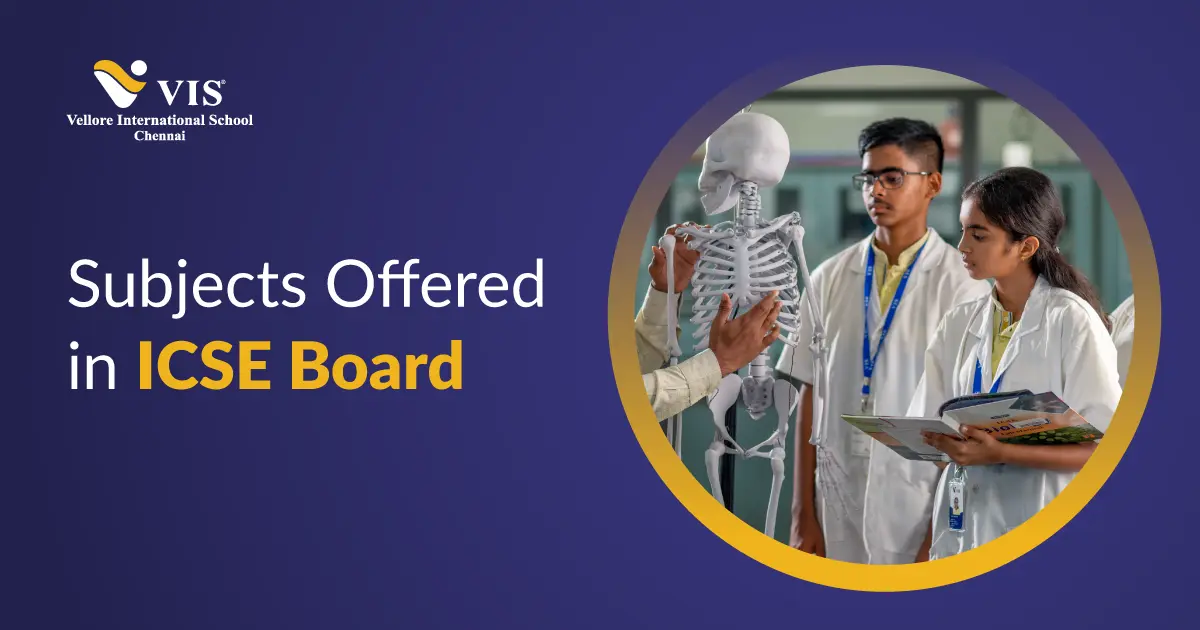
Practical work exists as a requirement for students learning Physics along with Chemistry and Biology in their academic studies. The educational laboratories maintained by ICSE schools give students opportunities to execute experiments while noting results which strengthens their understanding of theoretical concepts. The actual laboratory work helps students develop their scientific perceptiveness.
- Project Work And Internal Assessments
ICSE stands out by implementing project-based assessments that form the basis of its evaluation process. Each subject requires both projects as well as internal evaluations which contribute to students’ final examination scores. Students undertake research-based tasks where they show originality by applying academic knowledge through practical work, including modelling and chart preparation and written report production.
- Field Trips And Real-Life Exposure
ICSE supports extended education through the organization of school-based visits that take students to museums as well as science parks, factories, and natural settings. The educational excursions help students observe classroom material in physical settings which makes subjects more engaging for them. The learning experience finds its connection through world experiences.
Did You Know?
A survey by Education World revealed that over 70% of ICSE school principals believe practical learning improves classroom discipline and student focus.
4. Long-Term Benefits Of Practical Learning
School learning experiences through practical education create enduring foundations and here are some long-term advantages:
- Improved Academic Results
The process of active learning through practical engagements helps students grasp information better,r so their memory improves and their exam scores increase. The method changes complex subjects into memorable learning encounters.
- Higher Engagement And Motivation
Educational activities which allow physical involvement create greater student participation because they can construct and execute real experiments. The motivation remains high as students continue to learn and grow their subject love because of hands-on experiences.
- Better Life Skills
The acquisition of practical knowledge helps students strengthen multiple important competencies. The combination of skills develops students’ aptitude to manage school tasks and assess workplace needs and everyday challenges, which prepares them for future responsibilities.
Did You Know?
Studies by the Harvard Graduate School of Education show that students retain 75% more information when they learn through hands-on experiences compared to traditional lecture-based methods.
Vaels International School: Empowering Education For Tomorrow
In VIS Chennai we understand that education surpasses textbooks by creating significant learning experiences which form young students’ intellect. The institution maintains affiliation with the ICSE while connecting dynamic educational practices to robust learning ethics which develops leaders for tomorrow. Knowledge converges with creative thinking within a school that drives every student towards their specific path to achievement.
Conclusion
Students experience more excitement in education when they act on the lessons rather than solely reading textbooks. The ICSE curriculum advances when students incorporate practical learning because it develops stronger connections to the material while maintaining better knowledge retention abilities and obtaining practical abilities. The educational environment of our modern society requires practical learning methods because they have become necessary for building complete educational foundations.
FAQs On The Importance Of Practical Learnings
1. Which part does practical learning serve in the ICSE examination assessment? the
The practical learning approach serves as a crucial element in ICSE examination assessments including project work and internal assessments of Science as well as other subjects. Real understanding is measured by final scores and through these components.
2. How field outings have been established as mandatory elements of the ICSE educational system?
Field trips remain optional in ICSE schools, though almost every institution promotes them as experiential learning opportunities. Educational field trips match the curriculum content to enable students to bridge academic knowledge with practical applications.
3. Practical learning provides what advantages for slow learners?
Students benefit from this approach since the method lets them examine topics according to their individual learning speed leading to easier knowledge acquisition and a reduction in anxiety levels.
4. Do all subjects in the ICSE curriculum include practical instruction?
The curriculum for ICSE does not contain authorized practical classes yet it incorporates practical learning activities within its internal projects and assignments for geographic and historical studies as well as language studies.
5. What steps do parents need to take to assist their children with practical learning at home?
At home, parents should allow children to conduct simple tests while supporting video education and linking daily household work to school subjects to make learning engaging and relevant.