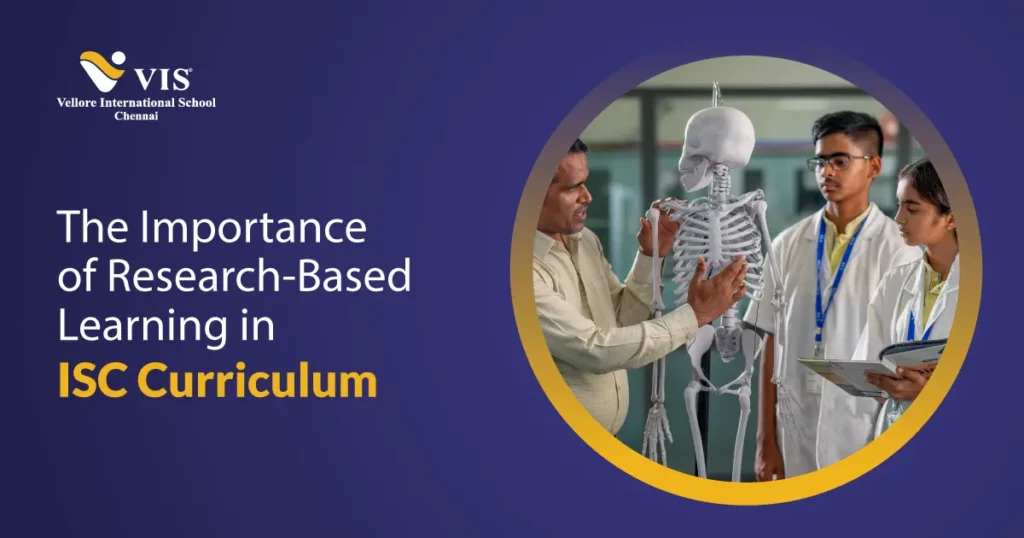
Education in the 21st century is no longer about memorising facts or reproducing textbook answers. It is understanding concepts deeply, asking meaningful questions, and applying knowledge to practical situations.
The Indian School Certificate (ISC) curriculum is widely respected for its academic depth and global relevance. At the heart of this approach lies research based learning in ISC, which transforms students from passive learners into active thinkers. This blog explores the importance of research based learning in the ISC Curriculum.
Understanding the ISC Curriculum Philosophy
The ISC curriculum is designed to go beyond surface level learning. It encourages conceptual clarity, interdisciplinary understanding, and intellectual independence. ISC places strong focus on written expression, research skills, project work, and analytical assessment.
One of the defining features of this curriculum is research based learning in ISC, where students are encouraged to investigate topics, gather data, analyse findings, and present conclusions in a structured manner. This approach nurtures curiosity and helps students understand the “why” behind concepts, not just the “what”.
At the same time, critical thinking in ISC ensures that students actively question assumptions, recognise patterns, and form reasoned judgements. These skills are invaluable in an era where information is abundant, but wisdom lies in interpretation.
What is Research Based Learning?
Research based learning is an instructional approach where students learn by exploring questions, problems, or scenarios rather than relying solely on direct instruction. It involves observation, hypothesis formation, data collection, interpretation, and reflection.
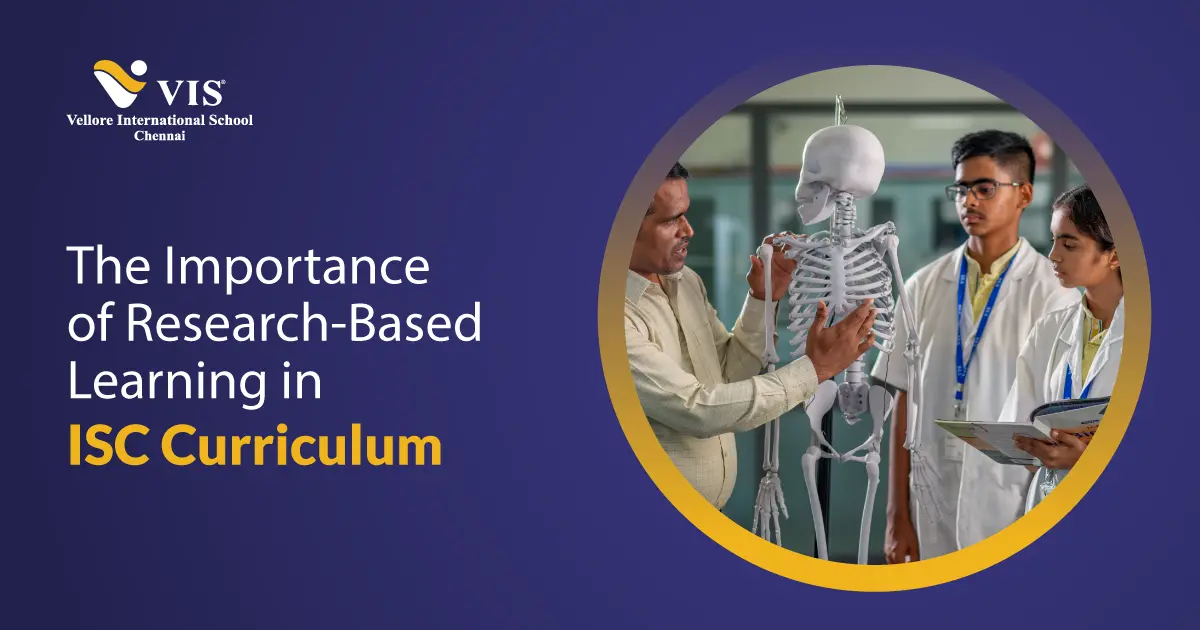
Within the ISC framework, research based learning in ISC is embedded through subject projects, investigative assignments, lab work, presentations, and extended essays. Students learn how to frame questions, validate sources, and present findings logically.
This method also aligns naturally with critical thinking in ISC, as students are required to analyse information critically, identify gaps in knowledge, and draw conclusions supported by evidence.
Why Research Based Learning Matters in Today’s World
The modern world demands thinkers, innovators, and problem solvers. Employers and universities alike seek individuals who can adapt, reason, and create solutions rather than follow instructions blindly.
By focusing on research based learning in ISC, students develop the ability to:
- Learn independently
- Think analytically
- Communicate ideas effectively
- Solve complex problems
- Make informed decisions
In parallel, critical thinking in ISC helps students evaluate arguments, distinguish facts from opinions, and approach challenges with clarity and confidence. These skills are essential for academic excellence, leadership and responsible citizenship.
A) Role of Critical Thinking in Student Development
Critical thinking is not an isolated skill, it is a mindset. It enables students to approach problems logically, assess multiple viewpoints, and avoid cognitive biases.
Through structured activities and assessments, critical thinking in ISC is cultivated across subjects such as English, Science, Mathematics, Economics, and History. Students learn to:
- Interpret data and texts
- Identify cause and effect relationships
- Evaluate evidence
- Construct reasoned arguments
When combined with research based learning in ISC, critical thinking becomes a powerful tool that transforms students into confident learners capable of handling academic and real world challenges.
B) Classroom Practices That Encourage Inquiry
ISC classrooms are dynamic learning environments where questioning is encouraged and exploration is rewarded. Teachers act as facilitators, guiding students through inquiry discussions and practical activities.
Examples of classroom practices include:
- Research projects and case studies
- Debates and group discussions
- Scientific investigations and experiments
- Literary analysis and comparative studies
Such practices strengthen research based learning in ISC by allowing students to engage deeply with content. At the same time, these activities enhance critical thinking in ISC, as students must defend viewpoints, analyse outcomes, and reflect on learning processes.
C) Assessment Beyond Memorisation
Assessment in the ISC curriculum goes beyond traditional exams. Internal assessments, practical exams, project submissions, and presentations play a crucial role in evaluating student learning.
These methods are designed to support research based learning in ISC by assessing a student’s ability to:
- Conduct independent research
- Apply theoretical knowledge
- Analyse and synthesise information
- Present ideas coherently
Additionally, critical thinking in ISC is assessed through open ended questions, application problems, and analytical writing tasks that test reasoning rather than recall.
D) Preparing Students for Higher Education
One of the key advantages of the ISC curriculum is its strong alignment with global education standards. Students who experience research based learning in ISC transition smoothly into university level education, where independent research and analytical thinking are essential.
Universities value students who possess critical thinking in ISC because they can:
- Handle academic pressure
- Participate actively in discussions
- Conduct original research
- Adapt to diverse learning environments
This makes ISC students highly competitive for admissions in India and abroad.
E) Interdisciplinary Learning and Holistic Growth
ISC encourages connections between subjects, helping students see knowledge as an interconnected whole. Projects often require students to integrate concepts from multiple disciplines.
Through research based learning in ISC, students develop a holistic understanding of topics, while critical thinking in ISC enables them to evaluate issues from scientific, social, and ethical perspectives. This interdisciplinary approach fosters creativity, empathy, and intellectual maturity.
F) Building Lifelong Learners
Education should not end with examinations. The true goal is to create lifelong learners who continuously seek knowledge and growth.
By focusing on research based learning in ISC, students develop the habit of inquiry that stays with them throughout life. Similarly, critical thinking in ISC equips them to navigate complex personal, academic, and professional decisions with clarity and confidence.
Role of Parents in Supporting Research Based Learning
Parents play a crucial role in strengthening a child’s learning journey, especially in an enquiry curriculum like ISC. By encouraging curiosity at home and creating a positive learning environment, parents help children develop confidence and responsibility in their studies.
Simple actions such as discussing current topics, guiding children to credible sources, and appreciating effort over marks reinforce research habits. When parents value questioning and logical reasoning, students naturally develop stronger analytical abilities.
The Role of Teachers as Mentors
Teachers play a vital role in nurturing inquiry and independent thought. In the ISC system, educators guide students through research processes, encourage questioning, and provide constructive feedback.
By supporting research based learning in ISC, teachers help students build confidence in their abilities. Simultaneously, they nurture critical thinking in ISC by challenging assumptions and encouraging deeper analysis.
This mentor approach creates a supportive environment where students feel empowered to explore and express ideas freely.
Vellore International School: Nurturing Thinkers and Innovators
At Vellore International School, the principles of inquiry, exploration, and excellence are deeply embedded in the learning culture. The school places strong emphasis on research based learning in ISC, ensuring students are encouraged to question, investigate, and apply knowledge meaningfully across subjects.
The academic framework at Vellore International School actively promotes critical thinking in ISC through interactive classrooms, project learning and collaborative discussions. Students are guided to move beyond textbooks and develop intellectual curiosity, creativity, and confidence.
Final Thoughts
The ISC curriculum stands as a powerful educational framework that prepares students for academic excellence and real world success. By integrating research based learning in ISC, it nurtures curiosity, independence, and intellectual depth.
At the same time, critical thinking in ISC ensures students become thoughtful, analytical, and confident individuals. At Vellore International School, these principles are brought to life through innovative teaching practices, supportive mentorship, and a commitment to holistic development.
In a world that values ideas, insight, and innovation, the importance of research-driven and critical thinking education cannot be overstated.
FAQs
1. What is research based learning in the ISC curriculum?
Research based learning in ISC is an approach where students actively explore topics through investigation, projects, experiments, and analysis instead of rote memorisation. It helps students understand concepts deeply, develop independent learning habits, and apply knowledge to real-world situations.
2. How does the ISC curriculum develop critical thinking skills in students?
The ISC curriculum develops critical thinking by encouraging analytical writing, problem-solving questions, debates, project work, and application-based assessments. Students are trained to evaluate information, form logical arguments, and think independently.
3. Why is research based learning important for school students?
Research based learning is important because it builds curiosity, improves understanding, and enhances problem-solving skills. It helps students learn how to ask questions, analyse information, and present ideas confidently.
4. Is the ISC curriculum suitable for students planning to study abroad?
Yes, the ISC curriculum is highly suitable for students planning to study abroad. Its strong focus on research, analytical thinking, and written expression aligns well with international education standards, helping students adapt easily to university academics globally.
5. How does Vellore International School support research-based and critical learning?
VIS integrates research based learning and critical thinking through project-based activities, interactive classrooms, practical assessments, and experienced mentorship. The school encourages students to explore beyond textbooks, think and develop skills required for the future.