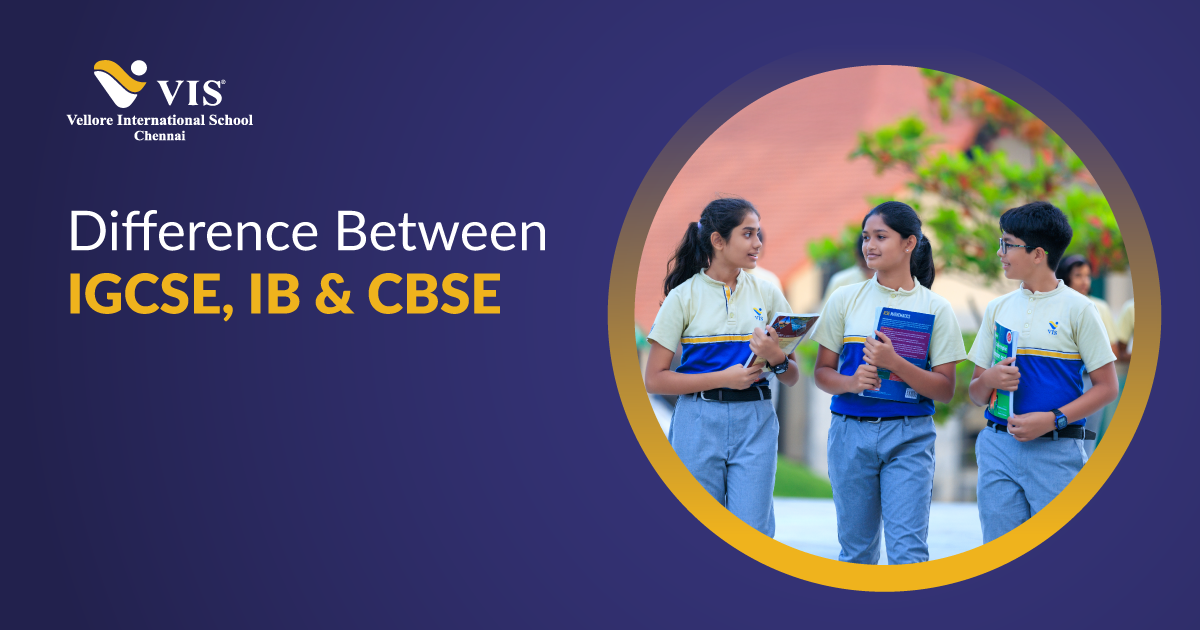
Comparison between IGCSE vs.IB, and IGCSE vs. CBSE is an important decision for parents to make when it comes to the right academic course for their children.
Because knowing the difference will help you understand the academic pattern and structure of the courses and which board is best for your child’s academic needs, whether it is for international education or Indian competitive exams.
Highlights of Various Board Differences for Right Academic Future
There is more than one school board for students, which makes them more confused when it’s time for selection. Students struggle with making the comparisons of boards like IGCSE vs. IB or CBSE.
In the current education system, the choice of curriculum is not an easy decision anymore. Because all these boards have their own academic patterns and recognition, parents and students need to make an informed decision before the admission.
Selecting the right board is not just about the child’s academic success but also about their confidence, skills, and future. So, we will explain the differences between these boards for you that will help parents
Understanding the Foundations of IGCSE Academic Programme
The International General Certificate of Secondary Education (IGCSE) is awarded by Cambridge Assessment International Education and aims to give students a good academic foundation with worldwide value.
This board is generally chosen by students between the ages of 14 and 16 years. With more than 70 subjects to study. This includes the application based on analytical skills and the assessments through written papers and practicals.
IGCSE is a good balance of academic and practical learning, which is suitable for students looking to achieve access to the international world.
Foundations of International Baccalaureate
The International Baccalaureate (IB) is a well-known international curriculum with a holistic and question-based approach to education. The main difference between IGCSE vs IB is that IB has various programmes for students. These are the primary years, middle years and diploma programmes where students can make choices.
These programmes emphasise critical thinking and research with overall personality development. Also, it has global awareness and provides intercultural understanding to the students.
Students who are more into an independent and research-based learning environment must go for this board.
Understanding the CBSE Pattern for Students
The most commonly used curriculum in the country is the Central Board of Secondary Education (CBSE) curriculum. It is best known for its syllabus and its association with competitive examinations like the IIT JEE and NEET.
The CBSE board has the structured curriculum for all the students that emphasises mathematics and science. The board is the best choice. for students seeking higher education within the country.
IGCSE vs IB: A Detailed Comparison
Aspect |
IGCSE |
IB |
| Learning pattern | It focuses on subject-specific knowledge with practical application | Focuses on interdisciplinary learning and inquiry-based exploration |
| Flexibility | Allows students to choose subjects independently | Requires students to study a mix of subjects across disciplines |
| Assessment style | Uses a combination of exams and coursework | Includes internal assessments, essays, presentations, and final examinations |
| Skill development | Develops strong analytical and problem-solving skills | Develops research, communication, and critical thinking abilities |
| Academic excellence | Moderately challenging with balanced workload | More demanding due to extensive coursework and independent study |
IGCSE vs CBSE: Key Differences Every Parent Should Know
Aspect |
IGCSE |
CBSE |
| Curriculum | Flexible with a wide variety of subject choices | Fixed syllabus for all students in country |
| Teaching methods | Focuses on understanding and practical application | The board focuses on theoretical learning and exam preparation |
| Assessments | Includes coursework, practicals, and exams | Primarily based on written examinations |
| Global recognition | Internationally recognised across many countries | Mainly recognised within India, but accepted globally |
Global Reach, Advantages & Choosing the Right Curriculum
While comparing the IGCSE curriculum with the IB and CBSE curricula, it is important that we also take a look into the global reach and the level of recognition for these boards.
The International Baccalaureate (IB) is currently being taught in over 5,600 schools across 159 countries worldwide
The IGCSE curriculum, which is a part of the Cambridge International curriculum, is currently being taught in over 160 countries around the world.
And the CBSE curriculum currently has over 27,000 affiliated schools across the world, with the highest number of schools being in India itself.
It is true that the CBSE curriculum is the most popular board in the country, but the IGCSE and IB curricula have much broader international exposure and recognition from universities around the world.
Factors to Consider When Choosing the Right Curriculum
The decision between IGCSE vs. IB, as well as IGCSE vs. CBSE, is not about which curriculum is better but which is right for your child. There are certain factors that you must consider when selecting the right board for your child.
1. The learning pattern and style
Find the learning pattern and style of your child, whether they enjoy learning practically or they are curious and independent learners, or they like structure and clear things. This will help you as a parent to select the appropriate board for them.
2. Identify the future academic goals
If as a student you have aspirations of attending international universities, the IGCSE and IB programs would be a great advantage. If you have aspirations of attending Indian universities, the CBSE programme would be a better fit.
3. Long-term adaptability
While it is possible to switch from one curriculum to another, it is important to note that it is also a very academic challenge. Therefore, it is important to plan your future and the board for studying for the long term.
Vellore International School Guides Every Learner Towards the Right Academic Path
When you are struggling with the IGCSE vs. IB or vs. CBSE, then you must come to us at Vellore International School. We know the importance of selecting the right board in shaping your academic and professional journey.
We go beyond simply offering guidance to the parents to ensure their child is placed in an environment where they can truly excel. All this is achieved through offering the personalised academic counselling and identifying the strengths of students.
We encourage academic excellence and also critical thinking with creativity among students and provide the proper understanding of each board, helping families make informed and confident decisions.
By combining expert guidance with a deep understanding of global and national education systems, we ensure that every student is equipped with the knowledge, skills, and mindset needed to succeed in an ever-changing world.
To wrap up: Making a Confident and Informed Choice
Therefore, the discussion about IGCSE vs IB or IGCSE vs CBSE is something that is totally based on the student’s interest and the learning pattern.
Because the IGCSE offers flexibility and global relevance, while the IB offers depth, research skills, and holistic development, and the CBSE offers structure, affordability, and preparation for competitive exams.
FAQs
1. Which board is considered the toughest among IGCSE, IB, and CBSE?
IB is considered the toughest board because of the extensive coursework and research involved.
2. Is IGCSE more suitable for international studies compared to CBSE?
Yes, IGCSE is more suitable for international studies as opposed to CBSE.
3. Can a student change from IB to CBSE?
Yes, a student can change from IB to CBSE, but there might be a need to adjust, as the teaching styles might differ.
4. Is IB really worth the money spent?
IB is definitely worth the money spent, especially for students who wish to pursue global education and development.
5. Does CBSE prepare students for global universities?
Yes, but not as well as IB and IGCSE.
6. What is the major advantage of IGCSE?
Its flexibility and practical approach to learning make it highly effective.
7. Which board should be preferred for Indian competitive exams?
CBSE should be preferred for Indian competitive exams like JEE and NEET.
8. Do universities prefer students from IB schools?
Many international universities prefer students from IB schools due to their rigorous course structure.
9. Is IGCSE best for all students?
It should be preferred by students who prefer to learn through application.
10. At what age should a parent think of a curriculum for their children?
The decision should be taken at a time when secondary schooling does not begin.