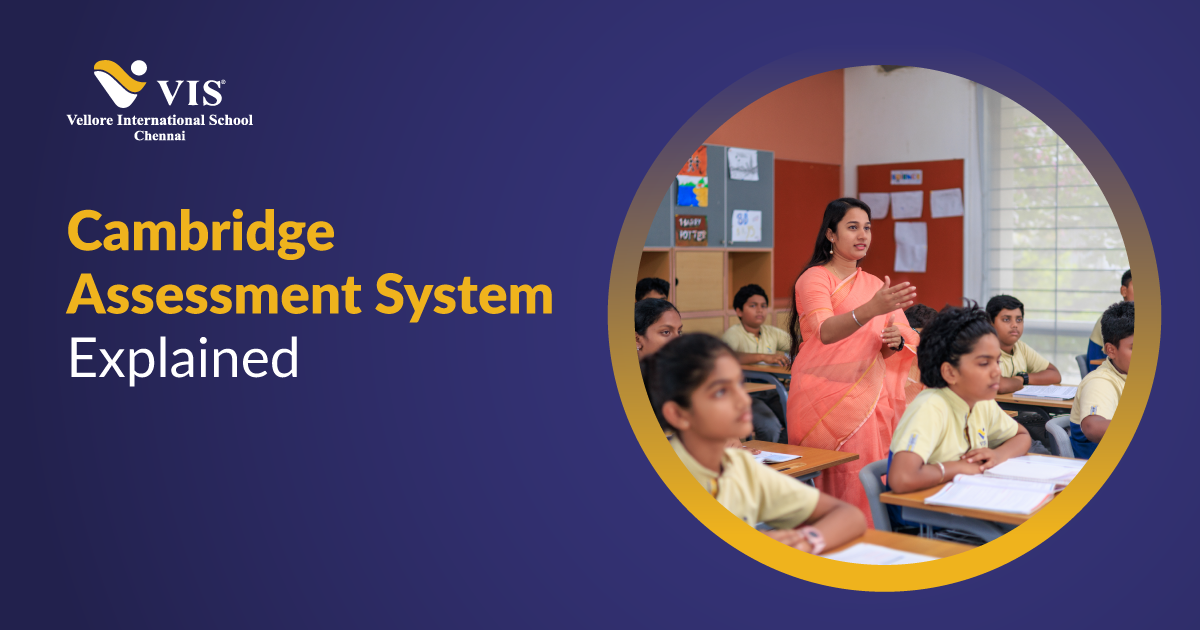
The Cambridge assessment system emphasises the development of skills, thinking, and understanding, rather than memorisation.
Feedback and evaluation are combined to monitor student progress. Understanding the Cambridge assessment system can provide students with global exposure, confidence, and excellence.
This system helps students achieve academic excellence and success in future careers.
Cambridge Assessment System Matters in Today’s Education Landscape
School education is no longer about scoring marks but now it focuses on building skills, confidence and better understanding. And within this the Cambridge assessment system
Works perfect for the students.
The assessment works in evaluating the ability to apply the global framework, which is helping students to learn and grow. If you are wondering how this assessment works, it is important to understand that it goes far beyond traditional examinations.
Students will get the continuous feedback, skill-based evaluation, and international benchmarking which ensures their progress. Within this blog we will discuss the cambridge assessment system and its works.
Cambridge Assessment System: A Global Framework Focused on Real Learning
The assessment system created by cambridge international education is called the Cambridge assessment system. The assessment is comprehensive and is based on the following parameters:
- Conceptual clarity
- Application of knowledge
- Analytical and critical thinking
- Problem-solving skills
Unlike the previous education, which relies on memorisation, the Cambridge assessment is based on understanding and application, helping students succeed not only academically but also in practical situations.
In a recent study it is found that the assessment system created by Cambridge International Education is used in more than 160 countries across the world.
How Cambridge Assessment Works: A Clear and Structured Evaluation Process
To fully understand the working of Cambridge assessment, you need to stay focused, as it is clearly a structured process. Here we have explained the complete working process of the assessment.
1. Continuous learning and preparation
The assessment pattern ensures that students are consistently examined through classroom activities, assignments, and guided learning. This helps in building a strong academic foundation before final assessments.
2. Multi-format examinations
Students are allowed to have multiple exam formats where their performance is monitored. This includes the written examinations, practical assessments and oral evaluations (where applicable). This approach ensures that students develop multiple skills, not just theoretical knowledge.
3. Expert evaluation and standardisation
All exam papers are evaluated by trained examiners they assure that the results are standardised in order to maintain fairness and consistency across countries.
4. Transparent grading system
Students’ grades are given based on performance across multiple components, providing a fair and accurate representation of student ability.
Types of Assessments in the Cambridge Curriculum
There are different types of assessments for the Cambridge curriculum, as these focus on higher-order thinking skills, preparing students for real-world challenges. These are:
-
Formative assessment: Learning through feedback
This type of curriculum includes formative assessments such as quizzes, discussions, and activities for students to identify their learning gaps and then offers the feedback to them which enhances their performance.
This shows that students can improve learning outcomes greatly.
-
Summative assessment: Measuring academic achievement
The Cambridge assessment system has a summative assessment pattern that comes along with the IGCSE board. Where the curriculum has AS and A-level programmes these exams help students understand a course of study at the end.
-
Diagnostic and progression assessments
The Cambridge assessment pattern also offers digital resources for students that include benchmarking student performance worldwide and provide instant feedback, which helps develop effective teaching methods.
Key Features That Make the Cambridge Assessment System Unique
-
It focus on higher-order thinking
Cambridge exams assess students’ analytical, evaluative, and application skills, not merely memory.
-
International benchmarking
Our students will be assessed at a global level, which will provide a competitive advantage for our students in the future.
-
Reliability and fairness
Each test is subject to rigorous quality control procedures to ensure its accuracy and consistency across the world.
-
Flexibility in assessment design
We can choose the combination of assessments that suits our teaching style best.
Benefits of the Cambridge Assessment System for Students
-
Encourages Deep Understanding
The assessment system helps learners to have in-depth knowledge of concepts by using the application-based learning method.
This system does not allow learners to memorise concepts. Rather, it helps them to understand concepts and apply them to real-life scenarios.
Research has proved that learning concepts helps learners to retain knowledge for a longer period and improves their academic performance.
-
Builds confidence and Independence
The assessment system helps learners to understand their strengths and weaknesses by providing them with constant feedback.
-
Develops critical thinking skills
The assessment system of Cambridge helps learners to develop critical thinking skills. It does not allow learners to memorise concepts. Rather, it helps them to think critically and solve problems. This helps them to tackle complex academic and real-life problems.
-
Prepares students for global opportunities
The Cambridge qualifications are recognised globally in over 160 countries. This has provided students with opportunities for higher studies and employment opportunities globally.
Challenges That You May Face in Cambridge Curriculum
The Cambridge assessment system can be challenging, especially for students who are used to the conventional rote learning process.
However, we have proactively provided students with academic guidance and have helped them develop skills in the Cambridge learning process. With the proper guidance and focus, students have not only adapted to the learning process but have also excelled in the process.
Vellore International School Brings the Cambridge Assessment System Every Learner
At Vellore International School you will find the answer to how Cambridge assessment works. Because we do not treat assessment as a one-time event, we make it an integral part of the learning journey.
Here the team and experts ensure that every student receives the fair and constructive feedback that helps them in improving themselves.
The assessments are used to personalise teaching strategies and learners are prepared for global standards with confidence. This makes us different from others and allows us to support the academic growth of students through mentoring and guidance.
We focus on making students not just exam-ready but life-ready.
Final Thoughts: Why the Cambridge Assessment System is the Future
It is important for parents and students to understand the Cambridge assessment system and the way in which Cambridge assessment works if they are looking for something beyond academic success.
The assessment system is a learning environment that encourages curiosity and helps students develop skills in order to succeed in the ever-changing world.
It is also a combination of continuous assessment and evaluation, and when done correctly, as we are able to achieve, it is the perfect way to develop confident and capable individuals.
FAQs
1. What is the Cambridge assessment system?
It is a global assessment system that assesses learners through continuous and final assessment of skills and understanding.
2. How does the Cambridge assessment work?
It works through formative assessment, coursework, and final examinations in a structured manner.
3. Are Cambridge examinations difficult?
Cambridge examinations are concept-based and not memory-based, making them more effective than memory-based examinations.
4. What is formative assessment in Cambridge?
It includes ongoing assessment to enhance learning through feedback.
5. What is summative assessment?
It refers to final examinations to assess academic performance.
6. Are Cambridge qualifications recognised globally?
Yes, they are recognised at universities and organisations across the world.
7. Do Cambridge assessments include practical examinations?
Yes, depending on the subject, practical and oral examinations are included in assessments.
8. How are Cambridge examinations graded?
Grades are based on performance and graded accordingly.
9. What is Cambridge Checkpoint?
It is a progression test to assess student performance at different levels.
10. Why should I choose the Cambridge assessment system?
Because it is based on skills and understanding and is more practical, making it more effective for learners to succeed in the long run.